A recording of a talk presented by John Tierney and Patrick Leahy to the Institute of Archaeologists of Ireland on Sat 18 April 2026.
This is a transcript of the presentation by John and Patrick. It was transcribed with otter.ai and typos fixed used Claude.ai and a little bit of human editing.
John Tierney 0:01
Hello John Tierney here, and I am going to present this slideshow that we showed last week at the Institute of Archaeologists of Ireland. And on the theme of connections, I co-presented the talk with Patrick Leahy, a historian and farmer in Ontario. And the first part of the talk is about connections that we're working on with the past, whereby the Peter Robinson immigration, which happened 200 years ago, and its descendants, are now cooperating with communities in Ireland, in Munster in particular, where they came from. And we are working on a history of families and an archaeology of families, and the talk is about that. But the second part of the talk, then, is about how, as a field archaeologist, I feel archaeology is changing because the arrival of new tools like AI and LLMs, and I'm going to address that in the talk as well.
So I had stuck this slide in Saturday morning before the talk, because I had actually managed something that I had been trying to do. Effectively, what happened was I took one of our family gravestone photographs. I uploaded it into an AI. I gave it a very simple instruction: transcribe this headstone. And it actually gave me a good quality result: "Erected by Timothy O'Sullivan in memory of his beloved father, James O'Sullivan" and so on. Now what was remarkable about that is that it wasn't an LLM in the cloud accessed via my browser on my laptop. This was an AI on my iPhone. So what that tells me is that if I can gather live data from photographs on my iPhone using an AI, then I'm also going to potentially be using this in the field for excavation work and field recording and so on. So there's big changes based on these new tool sets, and I think we need to be talking about them.
So the project I'm going to talk about in particular is the main project we've been working on for the last 16 years, is the Historic Graves project. Go to historicgraves.com - it's a community archaeology project, started as such, but most of our funding was for genealogical work. And what we have is we've about 1,000 graveyards all over Ireland recorded with community groups, funded by a variety of funding bodies such as LEADER local action groups and Heritage Council and many other groups like that. And we've over 1,000 surveys online. The database is based on Harold Mytum's data schema, which I'm not sure when Professor Mytum wrote that - maybe the early 1990s - an incredible piece of work, and we just took his data set and said, Okay, now build a database that is based on his stuff. And I'm going to talk about that later on. You can actually do it more powerfully than basing it on that now - we can do it by baking it in.
So most of the work that we've done in historicgraves.com is done with community groups. There's a small number of professional surveys that we've done, but I suspect it's one of the largest collections of archaeologically driven headstone assemblages in the world, and it's got a lot of potential for archaeological analysis and historical analysis. Most of what I'm talking about today is funded by two different funds. There's the Royal Irish Academy who grant aided us - the Commemoration Fund grant aided us to go to Canada last year, and that was fantastic. And then also, most of my time spent on working on the data side of community archaeology and community genealogy is funded by an EU Horizon project called SECreTour. And most of my ruminations on AI and LLMs are based out of the SECreTour project.
John Tierney 3:58
So this is what the map of Ireland looks like now, where we've received funding, where we follow the funding, basically, and where most of our work has happened, and 1,000 graveyards done and published online, freely available and downloadable by the community groups and owned by the community groups - it's all very positive. And in the last couple of years, we've also begun to realise that we can now actually improve the quality of the data we have by backfilling data into it. And the AI is becoming a big part of that.
This smaller image on the right shows the core area for this Peter Robinson immigration I mentioned: 1823 and 1825, 11 ships brought 500 families or thereabouts, over 2,000 people, to farms in Canada. And the name and date and age of every person on that immigration was recorded and is known. And there is a big movement across the North American continent for families to trace: are they from this known immigration? And it's got a big following, and we were very fortunate to meet one of the core community groups who were related to Peter Robinson's - in the 1825 group, a lot of families went to Douro in Ontario, and a lot of those families are still there in an island of Irish ethnicity in this massive continent, and we've been working with Patrick Leahy. He was my co-presenter. Patrick is a local historian, but he's a trained historian with a Master's in history, and he's farming in that land today, nearby where his original ancestors had a farm.
I first got involved with the Peter Robinson immigration through the Ballyhoura Rural Development, and then they brought us in on that project there. And you can see a lot of the blue pins that are on the map there - there are surveys done to follow. Can we actually fill out a map in Ireland to find out, potentially, where these Peter Robinson immigrants left from, and then link graveyards in Ireland to the graveyards in Canada.
And this is the result of what we're doing. Now this is a search for the Condon surname. If you go into Historic Graves, go up to Explore, down to Names, you can search by surname. Most of the Condons that we've got are in the south of Ireland. But now you see a little group over there in Ontario, and they're Condons who actually went over in the 1820s. So the map is filling out, and that's our purpose. By using archaeological principles of field work, by using computer science methods of data management, we are connecting people together, and we are giving people common cause and doing grassroots heritage, which I think can be very powerful.
So we surveyed 135 of County Limerick's graveyards, and 171 of Cork's graveyards. The Limerick ones, for a year or so, also involved archaeologists Colum Hardy and Will O'Seaghda, and they did high quality surveys with communities all over the county. And last year, with the Royal Irish Academy funding, I had the good fortune of going over to Douro and surveying the old ground of St Joseph's Cemetery over there. And we did use the same technique there as we use all over Ireland: masking tape and a marker. You stick the number of the gravestone on the shoulder, and then you take one photograph of every numbered monument. And then you fill out a record sheet.
And in this case, you can see a very Irish looking gravestone: "Erected by Roger Fahey and Ellen Conway in memory of James Fahey of Douro, their beloved son, native of Tipperary, Ireland, who died 1851 aged 26." So Patrick has the presentation to go later. He'll give some more information on this, but my main point is that we actually just use a standard methodology, a standard survey system. We filled out record sheets. We did test AI tools, which I'll talk about in a minute, but primarily what we did was we ended up producing a spreadsheet.
And all field archaeologists know that the spreadsheet is one of our most common tools. When we surveyed the gravestones and wrote down the full inscription and then typed them into a spreadsheet, and then Patrick went and checked every single detail from that spreadsheet, and then we uploaded that into the website. And once the photographs are uploaded with their geo tags, that forms a map. When all the data is typed in, you can then download it all as a new or fresh spreadsheet, and that spreadsheet comes down as a CSV file or as an XML file.
And the CSV is very powerful. What it does is gives you a column of data with unique identifiers. So this is the only gravestone with this particular unique identifier in the world. So we'll always be able to track it. And then it splits it into first names, surnames, year of birth if it's there, year of death which is often there, ages.
John Tierney 8:58
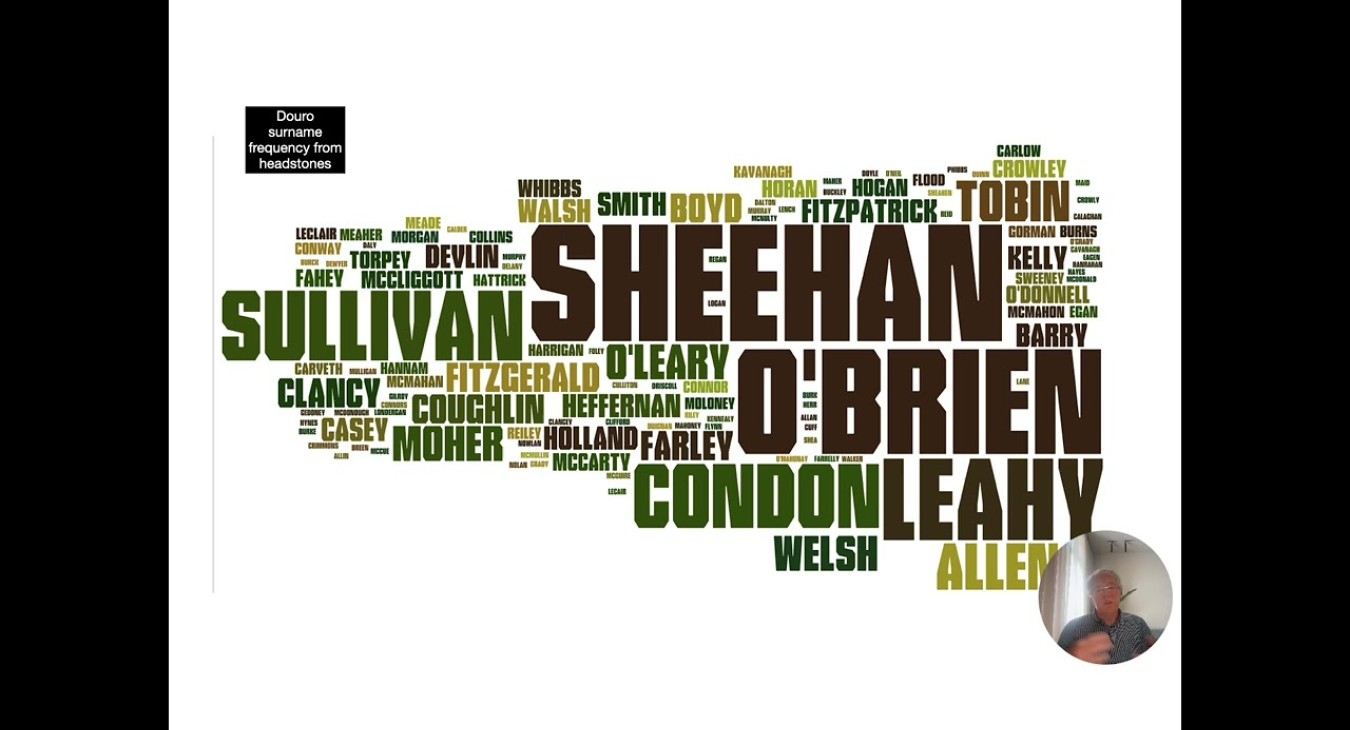
And then familial relations can be included, full inscription, and then also you can get longitude and latitude, amongst other things, inside a spreadsheet like that. And my point is that, until recently, we were simply using those CSVs to produce these relative frequency graphs - that the larger the surname is in one of these graphs, then the more commonly, the more frequently it occurs on gravestone inscriptions. So this is Douro surname frequency from the old ground. And you can see what I loved about it was it's pure Sullivans, Sheehans, O'Briens, Condons, Leahys, Allens, Welshs. It's a very strongly Munster assemblage of names, and I was just using the spreadsheet to produce this. And then there wasn't too much else I wasn't able to do much else.
But since the arrival of AIs, we are now taking those spreadsheets and those XMLs, and we're doing far more complex things with them, not just making interesting graphs for fingerprinting a community - we're actually able to do much more analysis, and we'll get to that in a wee bit.
And one of the key things for me as a field archaeologist is that what I've learned is that our training, whether we were training with the MoLA excavation manual or since we started doing the graveyard studies using Harold Mytum's data schema, which subsequently changed into what they call the DEBS data schema - it's a spreadsheet with 40 different columns or 40 different tabs, and with lots of lookups, combining the tabs and things - a very powerful data sheet, almost too powerful in a way, particularly for community grassroots heritage projects, very difficult for a professional to learn well, and for absolute beginners, I'm not sure that it's actually easy to fill out.
And now what we're learning is that with the new tools, the new LLMs, that things like Mytum's schema become easier to use and easier to adopt. So to do our 1,000 surveys had taken us 16 years, and in a way, we kind of got burnt out. There's only so much energy we could keep putting into it, and we sort of hit a wall about two or three years ago. And fortunately, that hitting the wall, in a sense, coincided then in 2023 with the arrival of the LLMs, which could do optical character recognition from handwritten field sheets.
So what happened during COVID was we still got a lot of people turning out for surveys, but they weren't the same people who had previously been doing a lot of digitisation, and we found that digitisation was suffering. But then straight away, the LLM was able to take our handwritten record sheets and type it up to over 90% quality, and then also put it into spreadsheets which we could import into the website. So that was a shot in the arm.
And then another major shot in the arm is when we were invited by the Douro 200th Anniversary Committee to go over to Douro and survey their graveyard there. And here you see the open day that was held in Douro on the anniversary weekend last July, and there's Patrick in the white t-shirt talking about it. And for me, that was a major shot in the arm, because it was my first time going across o the North American continent, and I hadn't really seen what the corresponding assemblages were like over there. I knew it was high quality stuff over there, but I just didn't have the experience. I didn't know how to connect it all together. But that weekend, and also liaising with Annette Dunford and Patrick, who did a lot of the graveyard recording, was just an absolute mind expansion.
So to give a look here, now what I'm going to do is see can I play Patrick's presentation and you can let him speak for himself.
Patrick Leahy 13:11
We find ourselves here in this historic section of St Joseph's Cemetery, the section we surveyed with John last summer. The 138 gravestones here, all facing east. After that point, the gravestones are facing north, after changes in cemetery layouts were permitted by the Church. Of the 138 gravestones, there are two that are very much Irish in character. They're limestone, like this one here, which is a great example in front of us - they're limestone, they're a little narrower in profile than a typical Irish gravestone of the time.
On this example here, that of James Fahey, we see a cross with an IHS on the top of it, denoting that he's a Catholic, a chalice and a tree of life type of motif over here. But what's most interesting about this stone, I think, that really bridges the connections between Canada and Ireland, is that James Fahey is a person of two places. The stone is erected by his parents, Roger Fahey and Ellen Conway, in memory of James Fahey of Douro, where we are here, their beloved son, native of Tipperary, Ireland.
So in this stone, we see that James Fahey, who died at age 26, he is a person of two places. This is a family who came here as part of chain migration to find people from home, to seek refuge during the famine. And when James died in 1851, his parents wanted to make it clear to posterity that James was a native of Tipperary, but now he was a person of Douro.
We're in a family cluster here belonging to the Allen family. The Allen family is unique here in Douro. They're still owning the same land that they received in 1825, 200 years on. And this is a cluster of the gravestones of the first generation of Allens who came here. Something that we see in about 40 of the gravestones of the 138 in the old section is reference to an Irish place of origin, whether that's county or, a little more rarely, parish. These people wanted us to know, wanted those who follow them to know where it was they came from. And we see several Irish parishes in North Cork and into Limerick as well referenced.
So we see here: "Erected by Patrick Sullivan in memory of his wife, Bridget Allen, a native of Mitchelstown, North Cork" - to see that carved in stone there. And there is, of course, throughout the cemetery, a variation in spelling. So you see Mitchelstown spelled two or three different ways on the seven stones it appears on. And the Allen family here has three stones in a row. Their name is spelled - the last syllable - E-N, I-N and A-N on these three stones of immediate family members.
These people, when they would go in to order the gravestone for their loved one, they would often give a verbal order, and the clerk recording the order for the stone would record it as they heard it phonetically. And that, I think, is why we start seeing different spellings throughout stones that are even presented beside each other.
So as we go across, we see that the Allens, the next older generation, were native from Limerick, County Limerick here. And as we go on to the stone of Edmund Allen, who was the father who led a large family here in 1825, we see he's a native of Galtee Valley, County Limerick - a neat stone that really jumps out once you start to dig into it.
The stone in memory of John O'Leary, native of County Cork, Ireland, died August 6, 1850, aged 70. But most significantly here also his wife, Margaret Callaghan, died January 10, 1824. This is a family that came to Douro in 1825. There are no Irish families - no Irish Catholic families - in the area here before that year. Significantly, Margaret is memorialised as dying in 1824. Of all the people buried here in the historic section of St Joseph's, she's the only person memorialised who's buried in Ireland - a unique detail that jumps out to us with our local history here, and something that her family, 25 years on, wanted to note: that Margaret, their mother, had died before they ever came here.
This is perhaps one of the most unique stones as well in the cemetery in terms of Irish place names and connections from Canada to Ireland and connections in the land, both here and at home. In memory of Dennis Leahy, who died July 15, 1860, aged five years. So we've got a young boy named Dennis up here, and a Lamb of God motif, sacrificial lamb, represented by Dennis himself as a child dying.
Patrick Leahy 17:58
It was erected by his parents: by Dennis Leahy, native of Mitchelstown, also by his wife, Mary Maher, native of Kilworth, County Cork, Ireland. We work with this, we realise "Calvert" spelt like this is Kilworth, as we'd say today. And if we go back into the records, we see Dennis and Mary - they were from neighbouring townlands. They were in different parishes, but Dennis was in the townland of Crochta Beg in the very south eastern tip of Mitchelstown parish. Mary Maher there at Ballynvohir up on the Kilworth Mountain, close to the border with the Mitchelstown parish. So these were neighbours at home in Ireland, and they left.
Dennis came to Canada in 1825, and they settled on a farm - Concession Six, Lot 10. Mary came six years later, evidence of chain migration. They settled further down in the fifth concession, about five kilometres away from Dennis, much like they were at home. So they married, and they built up a number of farms here, they built up a business, politics - they engaged in many aspects of that. Dennis, we know, was literate. Mary was highly literate, and she was a driving force behind their family success.
We see a change in style. Dennis dies here. The stone beside it - we see evidence of American style around the top, a marble stone with some degree of shamrock or a clover motif in here. Names change, spellings change. Mary Maher, M-A-W-H-E-R, spelled here in 1860, becomes Mary Maher, M-O-H-E-R, as the spelling standardises in Canada in 1884.
So here we have connections at home on the land, here in Douro on the land, preserved forever in stone, on the land on this hillside in the cemetery. We hear voices. We hear voices from the past. We hear pronunciations: "Calvert" for Kilworth, "Maher" for the name. Those speak to us across time and across the Atlantic Ocean as well.
John Tierney 20:09
So listening to Patrick: people of two places, hearing voices from the past, hearing pronunciations - it's very powerful stuff. And all along, I thought we were studying gravestones, and then we learned very quickly that the gravestones were very important tools, because the gravestones could actually be linked out into the parish, into a homestead. And listening to Patrick, he's talking about the land. So it's combining headstone to homestead to land. And to me, that's a very powerful archaeology that we're building with community groups at the moment. And this being an archaeology conference, I think that's super important as an archaeologist. I think it's so important that the names and dates carved in stone and the places that are referred to on two different continents can make those connections.
So when we were preparing for this talk, I had followed up some of the Allens that Patrick spoke about and the Callahans, and I'd found them. But you know, one of the main connections that we've had in getting ready and working together is in WhatsApp. So we WhatsApp one another regularly, and we'll bounce ideas off one another and questions and so on.
And on Sunday week, Patrick sent me a message saying, "Did you look at the Condons in Brigown graveyard?" - which we had surveyed as part of this Ballyhoura project. And he said there's a group of Condon headstones, one of which is the Condons of Turbey. And he says, "I have the Condons of Turbey in the 1680s Autobiography of Devereaux Spratt." And he said, "I think the Condons of Turbey were the ones who had been the senior Condons of that parish, and potentially had been related in the mediaeval period to..." - that's the stump in Hidden Voices. The Hidden Voices book - that's the stump of a Condon tower house in Caherdrinny.
And I'd already heard - Neil Donovan in Ballyporeen had already spoken about the Condons over in the Ballyporeen direction, and he has a fantastic methodology where he talks to the local people, and he knows the Condons who are still there, and he plots them on the map where they are. And it was great seeing him doing that, and then getting the prompt from Patrick to go and look at the Condons in Brigown.
So I went in and lo and behold, what we found was that this group - you see that's the ruined church there in Brigown graveyard. And this front group here, the black one and three limestones and the next black polished headstone, they're all Condons, and at least one of them is for the Condons of Turbey. And what I absolutely loved about this was that I was involved in the survey. The volunteer who typed up the data is an archaeologist, Evalina Chrobak, as I knew her at the time - Evalina Rondelez. Evalina, in her spare time, typed up some of those gravestones, one of which was the Turbey reference to Condons of Turbey.
And we all know in archaeology that gravestones near the door of the church is the next best thing to being inside by the altar. So it's high status ground, and therefore these are a high status group of Condons. And to me, what this modern survey of what's, let's say, a graveyard that has gravestones spanning about 300 years is now linking us back into the late mediaeval period, into the senior families of the old Gaelic lordships and so on. And I just loved that, that we're getting proper archaeological data from fairly modern burials.
John Tierney 24:05
So Patrick is the local historian there, but he sees the big picture. I have a link to one of his talks that he gave at a conference in Mitchelstown last year - a fantastic talk, very complex, very detailed, nuanced about what it meant to be an ethnic Irish group in a cluster, surrounded by other power groups. And so go and have a look at that.
So that's what it's about: showing connections between Munster and Ontario, and then also, I think, showing connections between just ordinary people doing their own archaeology and doing their own grassroots heritage and so on, and the potential things that we can be doing in the future.
And the second, quicker part of the talk now relates to the archaeological data ideas that I have in my mind. And I've been using AI now full on for a year and a half, almost daily, every week, and I've gone through the mill with it, in a way, and I've made some real blunders, and I've had some great successes. But I'm showing this slide of the streamer and of the sieve, just to show: look, AI is just another tool. AI has no intelligence. AI doesn't know what it doesn't know. AI has no drive. It has no ideas of its own. It's a great tool to use when you have a project in mind and when you want to design it and when you want to drive it and make it happen. And that, to me, is what AI is. I'm going to say it in a wee bit: it's a tool finder, and it's a tool maker, and it can be a very good tool to use.
And I'm showing the - what would you call that - a jam sandwich? My father-in-law used to call it - in Limerick they would say a sponge like that was a jam sandwich. But I'm showing that to show that when a data schema is baked in to a modern project, that's when you get really, really powerful. And I'll try and give an example of that a little bit.
What I'm basically saying is that if we have a data schema, like the MoLA excavation manual or like Mytum's DEBS schema, then you can take handwritten data - on the left we have - one of these is a context sheet from the MoLA manual, and the other one is the field record sheet from earlier this year, working with the students from Tramore Road campus in Cork, working on St Joseph's Cemetery there. And they basically recorded nearly 800 gravestones into record sheets for us, and we used their handwritten, visual human-derived data sets versus an LLM, AI-derived data set. And we compared one with the other. And the data set at that stage was based on Mytum, but now I realise if we had baked Mytum in, we would get higher quality results, and that's what we've been doing recently.
We've been using the LLMs. When I went to Canada last July for the first time with the Royal Irish Academy funding, we actually had an app - our first time in 16 years having a graveyard recording app. And that's it on the left. And it was basically a photo manager. I was able to take 1,000 photographs in a week. Every one of them was uniquely numbered and identified and stored into a backup folder offline. So it was very powerful.
And then on the right, what I'm showing is what the app has evolved into: into a visual classifier, so that beginners who don't really know, who haven't really done a lot of study and haven't done a university course on it, will be able to gather some data. And that's the basis that we're working on: some data is better than no data. And for the last 16 years, with the Historic Graves project, a lot of the data was deliberately incomplete because we didn't have trained people to do the recording. We didn't have the equipment, we didn't have the funding to do high quality archaeological surveys. So we said, Okay, let's do kind of a shotgun approach. Let's see how many surveys we can get done from which we can later on derive data.
And I'm not making that up. We kind of knew that there was going to be advances in technology which would allow us to post-process and backfill data. And it's happening now because of the AI and the LLMs. So the AI is allowing us to make tools that we need to use, but then it's also allowing us to do far more detailed analysis. And I'll just give one example of this.
John Tierney 28:43
We're using Directed Acyclic Graphs, which is essentially like a Harris matrix or a family tree. They are logical graphs that can only go in one direction. They can't actually be cyclical. In a family tree, your grandfather can't become your son, therefore it's a single direction. So you can use the DAG approach with data, and the AI will help you check your data. Have I mis-entered a stratigraphic relationship? Have I mis-entered a familial relationship? And DAGs help us with that.
RAGs - if you really want to look up, vector DBs - and start using them. But for now, most of us use CSVs, XMLs, doc files, maybe .md files. And what they are is we take our field data, we convert it into an XML, and then we show the AI that. And the AI doesn't drift and it doesn't hallucinate, because it's only looking at our data. And it can do very complex things.
For instance, it can look at an XML download from a survey which has lat/long in it, and it can say, "Oh, I can identify spatial groups because the lat/long are typed into a spreadsheet." It's not drawing a map, but it can visualise it as a map. So that's very powerful from an AI.
The other thing you can do is it can say, "Oh, if John's brother was Michael and Michael's grandfather was Michael, then John's grandfather was Michael." So it'll use logic for all those kind of things. So very powerful for that.
And then another example is what we do an awful lot in local surveys: we try and associate our 20th century inscriptions and dates to the 1901 and the 1911 census and now the 1926 census. And the problem with that is that the 1901 census and the 1911 census were both done in reverse for privacy reasons. House one in 1901 might be house 11 in 1911, so it's very hard to do a concordance. But now the AI does the concordance almost immediately as a trivial thing. So it's allowing us - we give it five minutes to do the concordance, and now we know that that is that family, because we can match the four names and the surnames and so on. It's very, very powerful.
And here I'm showing: archaeology.ie, excavations.ie, Landed Estates, Ask About Ireland. A lot of those data sets are freely available as open source data, so we don't actually have to go and scrape anything off the website. The National Archives actually has a full download button, and they want us to download their data. Do it ethically, do it the right way, but we can download a parish worth of data, and we can combine it with our field records.
This is so interesting that it's allowing us to do higher levels of analysis. We're not just doing data entry anymore. We're doing higher levels of analysis. And by cooperating with Patrick and his neighbours over in Ontario, we're actually doing the same levels of analysis on two different continents. We can take census data from Canada, we can take census data from Ireland, we can marry them into local data sets (such as gravestone transcripts), and then we can combine them. It's absolutely fantastic.
Now for me, who's been involved in Historic Graves for the last 16 years - a bit longer when it came from design - this is the first time now, with the AI and the LLMs, that we're actually looking at a full redesign. We're currently talking to the AI. We're doing design work with the human team. And then we go to the AI for technical advice, and we're looking at: can we backfill Mytum-type data? Can we backfill relationship data? And then can we match evidence sources? So the 1911 census, 1901 census, 1766 census, which we actually have for one of the projects related to Patrick in Kilworth - we have 1766, which just came out. And so we're now redesigning because we feel the AI can allow us to be more ambitious.
John Tierney 32:57
What absolutely is most important in all this is that, as it stands, using cloud LLMs and API calls, which is what we need to do to be in a stateless condition to get high quality results - so we need to use API calls - all that is happening in the cloud, and that's all happening with big tech. But the thing is, it's not just big tech who are actually developing AI, it's big tech and it's open source. And the open source side of things is extremely, extremely important.
And this slide is to show that - that's one of our photographs from a gravestone in Ardmore, County Waterford. We did side lit photography, seeing what Ken Williams was doing under a Heritage Council funded project last year in Tipperary, in Burgess graveyard. Fantastic photographs came out of that. And I said to myself, if we could use the side lit photography and pump them into LLMs, then the quality of our inscription recording will go up.
And this slide is to show: this is not the cloud. This is a local LLM that, let's say, I own. It's only on my laptop. It hasn't gone to the cloud. I haven't had to share private data outside of my actual laptop. And on last Wednesday week, I used Gemma 2 9B - 2 9B, whatever - to read that one gravestone, and it was okay. And then on the Thursday, I used Qwen 2.5, so these are all new models that are coming out on a weekly basis. And you run them on your laptop, and you set up LLama or - O-L-L-A-M-A - and then you run these models in them, and they are getting better and better. They're still not quite there, but they're getting better and better at a rate of knots.
And this is what brings me then to the first slide I showed. If you go to the App Store in iOS, download LocallyAI - that's the model that I used, was a visual analysis model. That's what read the gravestone for me for the first time on the phone. So I can't understate this fact: that you can run an LLM off your phone. My phone is five years old. It's a very good phone, but it's five years old, so it's not the most modern one. And we are looking at a revolution.
The examples I've shown here today and our collaborations with Patrick are all about people on the ground. It's all about people on their hands and knees, reading the gravestones. It's all about people collaborating, filling out archaeological systems and archaeological registers and archaeological sheets. And then we use the tools that are appropriate to the job, whether it's a flashlight or an AI - they're all just tools.
So I just wanted to show: things are about to change, and that as a profession, we need to be conscious of that, but also show that if we do it in the right way - and this is the ethos that we're bringing from SECreTour - if you do it for the benefit of and with the local community, then you're going to end up with something very powerful.
So I'm recording this on Saturday, the 26th. And actually, I finished the talk by saying: the Douro community are holding an open night this evening, an evening of history, heritage and music, Irish and Canadian. We are linking with one another. We're using the modern communication tools. We are fighting fire with fire. We're using the new tech for the benefit of ordinary people, and we are creating identities and relationships that are breaking down barriers and that are bridging the Atlantic.
So from Patrick and myself, I'd like to say thank you very much. These are the links I mentioned earlier. Patrick's one there - exceptional historical analysis. My own work, and then a blog post I wrote just talking about as I was working out how are we marrying into Mytum and so on. And then, what are the main things I've read that have really impacted me? "Science should be machine readable" - that's the OpenEval one. Yeah, that's a fantastic methodology for actually extracting verifiable claims (facts), a really detailed analysis. Then on multimodal headstone OCR, and then a Harvard student - I think he's Harvard - Noah Dasanaike, he wrote the clearest exposition for how to use the AI in the way we've been using it. And I don't need to write anything more because of the way he described it. He's done exactly what we did. He's done it, and he's shown other people how to do it. So read all of those.
Okay, thanks. If you have any ideas, if this means anything to you as a genealogist or as a community member or as an archaeologist, think on and get in touch. Slán anois.