A video of a talk given in the Round Tower Hotel, Ardmore, as part of Heritage Week 2025
Introduction and Heritage Week Context
Hello. Hi everybody. This is John Tierney, and I've got a wee slideshow here to follow on from a talk that we wrote and presented on Monday night as part of Heritage Week on the 18th of August. On Monday night, I covered a very broad brush strokes element of our approach to using historic gravestones as a data set for tracing historic families of parishes. And in this video, I want to show a bit more detail in relation to Ardmore. Aidan had advised me earlier how to connect to the big screen in the room, but I obviously got it wrong, so I went kind of off script for a lot of the talk, whereas now I want to go back and show some of the research that myself and Martha have been working on.
Since 2010 we've been working with communities all over Ireland to do community graveyard surveys, and we published them online to historicgraves.com the web platform that we run, we've worked with well over 600 community groups and have published nearly 1000 graveyards online, and they're all freely available.
And Ardmore is our home parish. It's where we test the technologies that we use elsewhere, and also then it's where we pursue ideas that we've gleaned from elsewhere, from working with people in communities outside of Ardmore, and it's kind of a cross fertilisation of ideas.
So we are working with communities all the time, and pretty much, I'd say, 90% of all the surveys we've done have been, have been community surveys with us. The project started as a field archaeology survey. That's what we do. That's that's our training. And we wanted to record gravestones and but quite quickly, we realised we had it wrong. We weren't recording gravestones. We were recording communities, family groups through time. The gravestones were just an element, a means of actually getting access into the families and the family histories. And the reason the project took off from an early stage is that most of the work is done by volunteers. There isn’t sufficient funding there for us to go and do this with a whole lot of teams, professionally trained people. So we depend on the permission of local authorities and the efforts of local communities. And what drives those local communities are things like pride of place, but then especially the desire to know what is carved upon their family headstones. They might find it hard to read them, whereas we can help them in doing that. And as most historic headstones in Ireland are later than 1720 then we kind of see them as being very good for working on social history of a parish from 17,00 let's say 1720, 1780, onwards. But we've come in recent years to realise actually you can get back further than that.
Historical Context: Plantation Period and Population Survival
I won't go into this slide too deeply. If you want to read it, you can click on pause, and then you can read it. But the key thing is that we're now thinking that if we can get headstones from the 1700s that's showing us potentially strong families of that period, and then potentially allows us to project backwards from that early modern period into the late mediaeval and that's tied in with Munster plantation, the Ulster plantation, elsewhere, other plantations, and that major shift that went from where the landlords were, the Gaelic aristocracy, the Gaelic Lordship, to being the Protestant ascendancy, and that all that turmoil happened, and from, let's say, the 1580s let's say just to the 1680s.
For me, as an archaeologist, I'm always loathe to actually jump and say, “Oh, it was genocide, and it was slaughter”, and was all that kind of carry on. I just didn't have the training for that. But now I noticed that the historians are publishing and are satisfied to now finally say that, yeah, Tudor warfare in Ireland, which was an expression of European warfare, had genocidal elements in it, and also into Cromwell's time. I know some people say, “Oh, sure, we all know Cromwell, it was genocide”. But I think if you're working on scientific facts, you need to actually take a cautious approach, and you need to actually work on the facts. And now the historians are saying, Yeah, we're seeing genocide there. All right, so the populations, the families that were studying in Ardmore, some of them, many of them, we think, survived the trauma of the 1580s, onwards,
The Earl of Cork, Richard Boyle's Influence
by the 1590s we all know Walter Raleigh has got some kind of association with Ardmore, but mostly it's the Earl of cork, Richard Boyle, an amazing character, and a guy who really nailed down the Munster plantation from West Waterford all the way to West Cork, up north into county Limerick and elsewhere. An amazing character based out of Youghal and had a major geopolitical influence in our country, and he definitely had a big impact in Ardmore; he was unusual because but he was those type of coloniser who actually reinvested the money that he was making from the land back into the territory. He put money into infrastructure, into bridges, roads, into industry and so on. So kind of a good guy but a bad guy kind of thing all on his own, but his influence. If we trace recent work on him, you'll see that his fingerprints are all over, Ardmore, and that the shift that went from the early monastic site into a, into a mediaeval place with the manor of Ardmore. The major change then was when he and his cohort took over in the late 1590s and into the early 1600s
Survey Results: 467 Inscribed Gravestones
So keep all that in mind when we're looking at the families of Ardmore in total in the graveyard. In the last few years, we have recorded every gravestone inside in the new ground and the old ground. This map here shows the the old ground fifth century onwards, and we have recorded 467, inscribed gravestones. 296, in the old ground and about 170 171 in the new ground. I won't go into too much detail on the burial practices.
Burial Practices and Locations
It's a talk for another day, but the main burial density is south of the cathedral. And as is the norm in Irish graveyards, most of the burials will be south of the ruined church, or in this case, cathedral. Number two, there's a dense group of late 18th and early 19th century burials around the Saint’s grave grave. So the Beanncháin is over there, and there's a very tight group in there, in the Catholic faith, the closer you are to the altar, the easier transition into heaven. Or if there's a saints grave, the closer you are to the saints grave, then then it will assist your ascension into heaven. So all those families, the hypothesis we have is that those families who are buried around the saints grave are going to be our middling to high status Catholic families of those late 1700s and early 1800s and I'm going to look at that later on and see, can that show us who these particular families were? And no surprise, we recognise a lot of the surnames. The spellings will be in older form, but the actual surnames will be some of the main families who were still in Ardmore here today.
Another group we have noted is inside in the the nave of the church, the west end of the Cathedral, the largest part of the ruin there that finally, when the cathedral went out of use, that became a little private burial ground, mostly for Protestant families. Then at the eastern end that was the earliest ninth century stone church, and then it continued in use as a church all the way up until the 1830s when Saint Paul's took over. So the Church of Ireland families continued to observe mass inside in that part of the church all the way into the 19th century. And the burials down in the nave then represented those particular families, or some of them anyway.
The New Ground Cemetery (1913 Onwards)
Then the new ground officially opened as a cemetery from 1913 onwards. But we have evidence that the actual burials were taking place in the new ground in advance of 1913 I think there's a Roch headstone there from 1906 and there's a Kennedy headstone from around 1897 so I think that's not uncommon. That burial would would advance before the officials caught up with it. So the survey work has been done by myself, by our colleague, Jacinta Kiely, Martha Hannon and Juliana Tierney, and all these names are written on record sheets. And this is what the record sheets look like in the office. It's five folders, 100 sheets each, and handwritten record sheets inside of all those they've been typed up by Juliana and a bit of technology. And this is what they look like. So for instance, in the spreadsheet, if we were to search for a particular family name, then it'll pop out for us. In this case, so we've searched for the Keane surname, which would be one of the bigger and longest running families in the parish. So in time, in a couple of weeks, what we're asking for our community members to help us is to identify the townland’s for every headstone. So we haven't got that. We have about townland’s for just over half of all the headstones that are in the graveyard. And we're now asking for assistance so once we've got that information in, we'll upload the full data set into historic graves into the website.
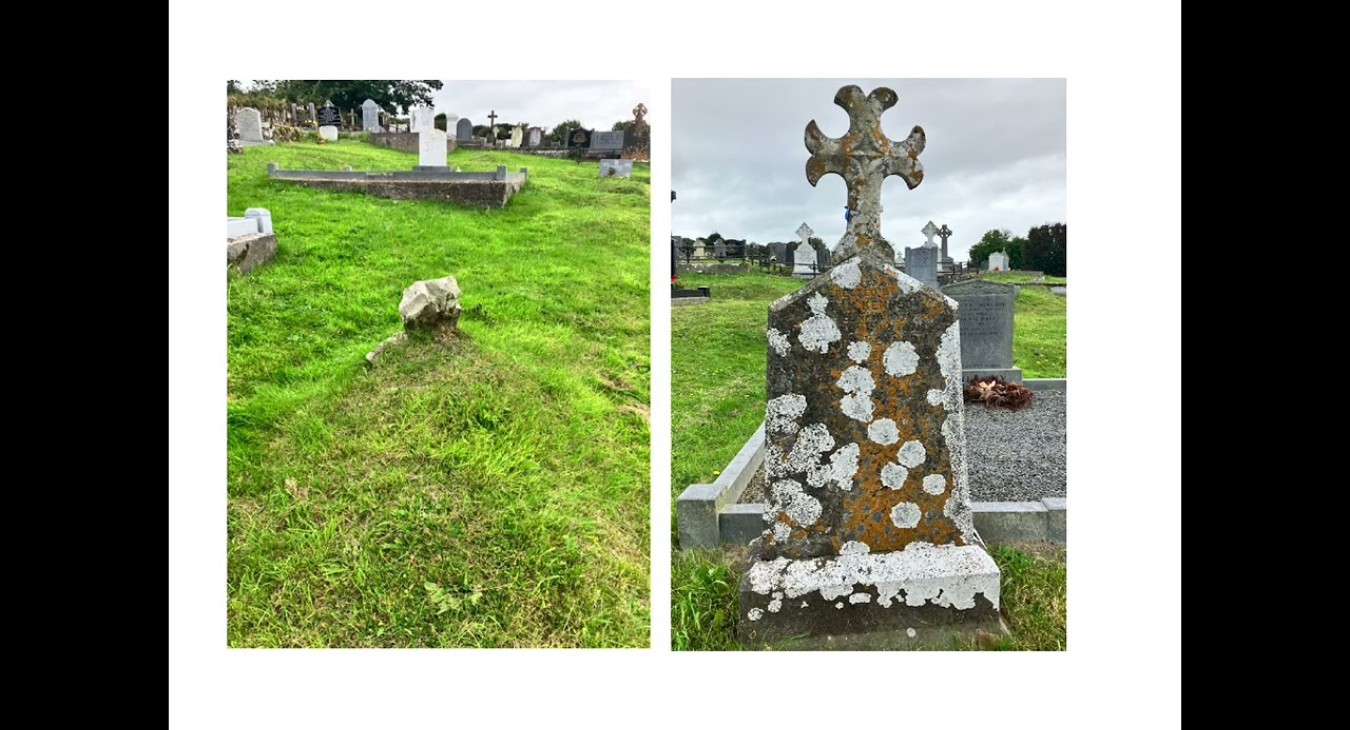
This is a map of the new ground, and it dates 1913 and it shows the new ground divided into sections A, B and C. So that's the top part of the burial ground, the cemetery there, and this is a close up. Then the new ground is essentially a cemetery added on to the old ground, which was essentially a graveyard. The grave spaces in the new ground. They're slightly different dimensions are shown on the cemetery map, but the average grave space is about four and a half foot by seven foot, and it's got a very broad range. It's got top end Church of Ireland, mortuary monuments. It's got your ordinary uninscribed grave markers, this one here on the left, a little grave hump and an uninscribed stone marking the head of the grave. And sometimes the grave humps also have a foot stone at the bottom.
The grave stone there on the right, it's a limestone late 19th century, 1895 1897 and it's for the Kennedy family. So you know, it's easy to say there look like if there's a headstone with Kennedy on it, and it's from 1895 then all we got to do is go back and trace earlier Kennedy headstones to see how long the Kennedy have been here. I was actually interested. After the talk on Monday night, I went into the bar to get a drink, and who was serving me but one of the Kennedy lads. So it's living culture, really. And the gravestones represent different generations.
Oldest Name Stones and Early History
Some of the photographs I'm about to show next are done from a community monument fund project we did during lockdown in 2021 Dr John Sunderland came down and took these really high class photographs for us. And these two stones in this slide are actually the oldest named stones in the graveyard, ogham stones, they're not in the primary locations, but the one on the left contains the name of a Sept from the fifth or sixth century. So that's a long, long time ago, and the name of the Sept were the NAD SEGAMON. A sept is like a tribe, but the historians don't like to use the word tribe in an Irish context. Now these NAD SEGAMON are believed to have been prehistoric kings of Cashel, so just before historic records started, which was around about time of Declan or time of Patrick, and the NAD SEGAMONs had control, we think of that part of south Tipp and West Waterford, and it could well be the aristocratic branch of the family that St Declan himself came from, from his homeland, up in up around Cappoquinn so in that second one on the left, and then the stone on the right commemorates a man called Amadu, or beloved. It's in ogham, and it's also in Latin. So in this fifth and sixth and seventh centuries, they don't have the surnames that we have today. They didn't start forming until around the 10th and 11th, 12th centuries. But these ogham stones are the first of the names
In 2021 Dr Paul McCotter searched a range of mediaeval documents or references to Ardmore, and with the Anglo Norman invasion of Ireland from 1169 onwards, Ardmore shifted from an ethnic Irish Lordship to mediaeval Anglo Norman control and Ardmore Manor was established in the late 1100s and it would appear that the Mernin family, M, E, R, N, I N, were the first of the Norman lords of Ardmore. A search of the 1901and 1911 census shows some Mernin families persisting over Clashmore direction and beyond in Villierstown.
Medieval Period: Mernin Family and Norman Control
And there's a lovely Mernin gravestone in Prospect Hall graveyard, looking across to Youghal over by ferry point. But we have no inscribed Mernin headstones in Ardmore, even though they're believed to be in the family who built the first of the stone tower houses are the castles of Ardmore.
At the same time as the Mernins, we probably had branches of the Powers who started as the Norman knights of de Paor or Le Paor. Now one of the dominant surnames in the county of Waterford. Not to mind in Ardmore itself, for instance, we have 20 headstones with the Power surname on, in the graveyard, and six of them date before the 1849 in terms of the Powers we still haven't identified, let's say a home townland for those families. So that's one of the bits of research that we're hoping to advance.
Medieval Grave Slabs and Cross slabs
In terms of the Mernins. Why don't we have stones with their names on it? If they were the top end knightly class of the 14th, 15th century, then this is the type of grave slab that we have in Ardmore. There's about 14 of these mediaeval grave and cross labs in the graveyard, and we're thinking some of these, and there's two grave niches as well inside in the cathedral. They're probably relating to the Mernin family, or relatives of theirs, who invested in mortuary monuments. So there's 14 of those types of stones inside in the nave of the cathedral and others then are dispersed out around the graveyard. This is one of them here. This is an upside down, roughly 14th century cross slab. You see we've outlined in orange the footings of a cross and then the shaft of a cross, and the rest of it is under the sod. So that's a body slab that would have originally rested on the ground, marking the length of a grave, and it subsequently is reused, then as a grave marker, as a headstone, but they're all hiding out there for us to see. That was a wonderful surprise. When we were reading headstones, we knew there was something funny about it. And then one morning afterwards, when the sun came out, we realised what it what it was, one of these 14th century grave slabs just reused.
Conventional Gravestones and Local Styles
This then will be the more conventional gravestones that we're looking at. And I love this photograph by John. John took the photograph of the front of the stone, and then also the back of the stone, and a lot of the late 1700s gravestones in West Waterford. You can go all over the gravestones from here all the way to kilgobnet and up to Mothel into mid Waterford and Clonea Power, and a lot of them are inscribed on the back. They'll have these cross designs on the back. Go over to Clashmore go over to Aglish. They're all there. So it's a local style. And this photograph, I love it too, because it's 1780s and it's for an Edmund Foulou, which is that local Irish pronunciation for Foley and so those the foulous that are Foleys are definitely contenders for being one of the longest running families in the parish of Ardmore. And this headstone takes us back nearly 275 years. Foleys are on 28 different headstones in the graveyard, and we have eight different townlands on the gravestones associated with them.
Historic Documents and Written Records
If we look at those different families, like Foleys, Whelans/Phelans, Powers, they're all contenders for these older surnames of the locality, but they don't really appear a huge amount in the historic documents of the 1600s Paul McCotter looked at a range of those documents from the 1590s onwards, when the Earl of Cork really put his heel on top of this part of West Waterford, and he brought in new English tenants who were represented by surnames such as Cock and Brelsford. And these can presumably match back to English localities associated with Boyle, but we need to doresearch on that. Otherwise, the main Irish surnames that are in the documents at the time are Fitzgerald, Flynn or O’Hornane, I'm not sure, but that surname could it be linked to Hurton. O’Hay or o'haley, and also the local naming convention whereby John the son of Daniel, for example, is evident with James Mac Morish. So James the son of Morish, but they don't tell us what the surname is for that particular family over in Crushea townalnd. But the warfare of the 1600s resulted in a lot of legal historic documents. And we do have a range of names there. I do remember all right now they're not here, but we got a rake of Mansfields in some of these documents as well. And we'll see Mansfields on the gravestones now as well later.
Penal Laws and Catholic Priests
So if we're trying to go from the gravestones and then go into the written documents and the fraught times of the Penal Laws. The really rough penal times from 1680 to about 1700 but from about 1700s let's say 1714/1715 the Catholic priests were allowed, if they took An oath of allegiance, I presume, to the crown, were allowed to openly practice their religion. And the names that we have for priests of the time for Ardmore is Richard Power, a romish priest of the parishes of Ardmore, Ligenan and Kinsalebeg, so the Powers, you know, in that period, you had to be high status to become a priest, or that's my understanding. But anyway, and after Father Power, we then had a father Morgan Sheehy who then took over in Ardmore and Kinsalebeg. So we've got Sheehy and Power there on written documents from 1714,
Families Around the Saint's Grave
Another source that I think has got a lot of potential for us in Ardmore is actually to look at the names that are on the gravestones over on the Beanncháin; the closer you could get to the altar in the eastern altar in the church, the more likely you were to go to heaven in the Catholic tradition. And then, if there was a saints grave in the graveyard, then the closer you could be buried to that then was a sign of status. There was probably extra costs being buried over there. So when we look at gravestones from 1700 to 1820 all around the Beanncháin, then what we're seeing is we're seeing the families who weren't on the written documents, but are on the gravestones. And it's Foleys, Foulous Powers, Whelans, whalens, Phalens, Morriseys. Spelt in a range of different ways. And then Mansfields, Rooneys, O'Neill's, Keans,, Kanes Troyss, I love Hankirkan, so that's the way it's spelt on the stone. But it's, it's, it's a phonetic, really, isn't it? So Hannigan, hanragon, hankerkin, Flynn, fling, Baron, a bit further afield we have Winns/Wings and Flynn’s/fling, I think this is the first picture really, of who we're seeing, who are the good sized farmers in the 1700s and potentially, are the tenant farmers who've persisted in the locality from the Gaelic Lordship that when to “Hell or Connacht” was pronounced by Cromwell and his subsequent successors, that a lot of families would have stayed on here as tenant farmers instead. And that's who we're trying to trace. And I'm thinking that here is where we're seeing the evidence for who they were - these 1720-1820 headstones around the saints grave.
Frequency Analysis of Surnames
So when we look at all the names that are on the gravestones, then we do a frequency analysis. This is just a rough way of saying, Look what are the dominant names that are on headstones. It doesn't mean who's buried mostly there. What it means is who's most got their names on a grave stone. So Foleys and Fitzgeralds, Cunningham Mansfield, Allen's, Troy's. That’s everything now that's 20th century, 19th century, 18th century. So it's just the broad brush strokes of who we are, and the, I think, just before the Munster plantation or then the arrival of the Earl of Cork, all that crowd, the Fitzgeralds, were the dominant of the old Anglo Norman families, the Old English, as they were called, and they were essentially running a Gaelic lordship. And those senior families, if they wanted to hang on to their land, and if they could survive the turmoil of Tudor times and Cromwellian times, then they would have had to convert to Protestantism. And they survive elsewhere, up the Blackwater valley, but the the farming families who are on the ground down here, they're very much here. So I think we can see our Fitzgeralds as one of our key links. So that would be the Anglo Norman side, going back hundreds and hundreds of years, and then the Foulou the Whelans, the Powers going back as well. I know there's nothing unusual in that they're all conventional West Waterford names, but when we actually quantify it, and if we can trace them to particular town lands and successions of townlands, that's where the real value will come out of this study.
The New Ground and 20th Century Burials
So if we go up to the new ground instead, and then look at the names that are on the gravestones there, like the new ground, has got a very high status Church of Ireland community up there, the Roch/e, Roch Perks. Graves there, I think, are from 1906 onwards. That's a fantastic high status group. The Beresford Poers, who were related to the Earls of Waterford, linked over to Curraghmore, for some reason, branches were buried over here. But then in the 20th century gravestones became more affordable. And it was a far more democratic era. And we're seeing the kind of the smaller size farmers now appearing on gravestones here, on this map of so these are we're seeing the medium sized farmers and the small farmers now appearing on gravestones. Does that mean they weren't there back in the time of the Munster Plantation? Maybe landlords would have brought in lots of tenants. They would have shuffled tenants around their properties. But could some of them have been here a long time? Yes, they could. And now we need to get facts for actually supporting that hypothesis and for testing it.
Population Crises and the Famine
So the major crisis of the Munster plantations and the major crisis of the Confederate wars and the Cromwellian wars and so on, affected communities all over Ireland and the next major crisis. Then after that, what happened was, after those wars, actually the native population, or let's say the Catholic rural population just skyrocketed from about 1700 onwards. By 1800 there was 6 million population earned. A majority of them were lower class Catholic labouring class, and they brought a major political heft with them, because there was huge amount of agrarian unrest, nighttime attacks and burnings and slaughters and all sorts of things going on, but that all came to an end with time of the Great Famine then, and when we actually look at the families who were here now, we must think that when we trace them on the valuations, that a lot of the families who were here today are also on Griffiths valuation from the 1850s onwards. So there are families here who survived the famine, and then branches of them, then who emigrated. We think, as a result of the famine, we presumed a lot of people had died. But the one actual bit of stats we have for the deaths during the famine, we found in this document, which records burials in Ardmore from 1847 to 1848 out of a temporary fever hospital, and it's 30 people died for that worst year of the famine. Now that’sextra people dying due to famine, starvation and fever. So it's not this mass, mass amount of death. Let's say it was two and a half people, extra people per month, 2.7 extra people a month dying. So it's not out and out crisis at a local level, but it must have been a turmoil for the families involved, and especially as they would have more likely been from the lower parts of the social classes.
Political Changes and Voting Rights
So democracy was a foreign concept here in these 1840s it was only developing, and what really worked was the rule of might. Might is right. And as the Irish Catholic population began to get bigger, they began to develop their might and then, but that all came to an abrupt halt with the famine that a million people died throughout the country, and a million people emigrated between 1845 and 1855 a million people were essentially economic refugees leaving this country, and that would have been branches of the family who couldn't hold on to the land, or who the landlords didn't want.
Before the famine, from about 1790 until about 1830 if you had land that was worth more than 40 shillings, then you had voting rights. And so a lot of the Irish, small Catholic farmers had that kind of property, and they had voting rights, so they had an element of self determination. Didn't do much good. The Act of Union still happened. And then when it thought it looks like things might actually improve, the with Catholic emancipation in 1829 they did a bait and switch, the Protestant Ascendancy at the time, and they said, “Oh yeah, we'll give you emancipation for freedom of religious practice". But they changed the levels for voting rights. So it went from a two pound level to a 10 pound level to an English rate. And so a lot of the voting Rural Catholic’s were now disenfranchised. They didn't have a vote anymore. So times were rough in those you know, you talk about, oh, the different Christian faiths were basically a constant conflict with one another, and arm wrestles, and they had to cooperate and they had to collaborate, but they were also in major competition and a major conflict. And the politics of that change from votes, it must have had an impact in terms of how the famine was handled from 1845 onwards, and because it was handled in by a series of blunders, also in a global context, you have to look at it that way as well and see what the different responses were. But I think, I think I'd be happy to say it was a series of blunders which resulted in major changes in land holding afterwards.
Land Ownership Revolution
And what happened was the English government, or the British government, allowed Irish small farmers to begin to buy their own land. And there was a major revolution, which we benefited from ever since. And so for a long time, for two or 300 years, we would have had small farmers who were tenant farmers, to landlords of the Protestant ascendancy and before them, tenant farmers essentially to the elite of the Gaelic lordship. But then from about 1880 onwards, the local Ardmore families started to buy their own lands, and it was a major revolution. And at the same time, then what we're seeing is that the families began to put up their headstones and continue to represent their status within their community by their, let's say, potentially, the gravestone mirroring the farm back at home. And then, when we look at all the surnames we've, I think it's 128 surnames that we have in Ardmore, because it became a kind of a villa location for a lot of the Ascendancy and a lot of the Protestant side of things. We've got a lot of Protestant names there, and some of the old Irish are surviving into that. And then most of them, then would be the kind of the smaller farmers and the medium sized farmers who are still working in Ardmore today. And so it's an interesting range, about 120 you'll often see that in Irish graveyards, maybe about 100 different unique surnames in the graveyard. But that might be with only 150 or 200 headstones. We've gotten almost three times that in Ardmore and 128 surnames that's a different collection of names that you'll get. Then you'll get inside in Dungarvan or in Youghal, or up to Cork are all over the country. So the surname has become a sort of a fingerprint for who's living in a particular community.
Future Plans and Conclusion
So with Ardmore tidy towns, as I wrap up, now as our partners, and we're now aiming to publish the gravestone book later this year, and we're looking for the community to help us to identify the towland for each of the families listed in the gravestones. And then by Christmas, we're going to publish the catalogue of the gravestones in the graveyard with the full inscriptions and the dates that we've gleaned off those and then a bit of text relating to the actual iconography on the stones, and let's say the information we can glean about the farms and so on.
So on Monday night, thanks to everybody who turned out. Thanks to Aidan and Trish for hosting us in the Round Tower Hotel, and for everybody who offered help afterwards and who shared stories of funerals and wakes and burials and so on. We aim to record a few local histories in the coming two months, and then after that, we'll we'll get the book out. Once we have more data added in the next few months, we'll upload all this data to historic graves where it'll be freely available, and then we'll publish the catalogue before Christmas.
The final thing I want to show is we're going to put out the pop up Heritage Trail in the next week or so, and that that's you can if you pause the video. Here, and you can download the digital versions of the trails onto your phone by using those QR codes. So keep an eye out for those in the in the coming days, and we're open to any stories from one and all. So this has been a traverse through the way we're thinking. We're still working it out as we go along. Ardmore is our laboratory, and it's a fantastic place, because the community have got a very strong pride of place, and we want to build on that, then apply that pride to the more academic side of things. And see, can we make this case? Can we prove our hypothesis that we can link all the way back into the Gaelic lordships by using gravestones. All right, lig mé ann mar sin é.