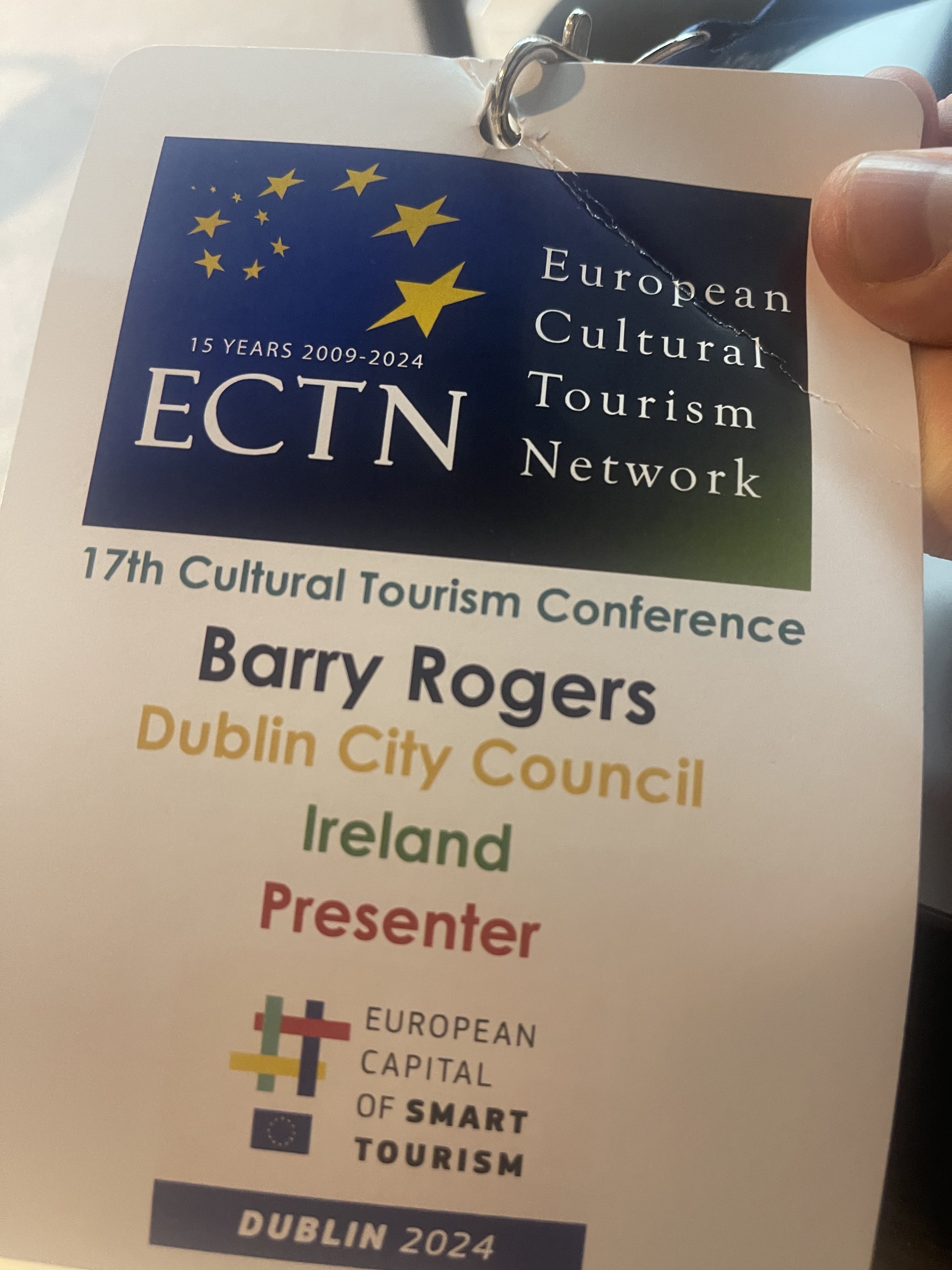
Barry Rogers Interview
Barry Rogers of Dublin City Tourism Unit spoke to us at the ECTN Tourism Conference in Dublin on the 24th October 2024. Dublin City's heritage app strategy is interesting as it aims to avoid the well known pitfalls of apps such as forming closed silos, dying on the vine, and problems with Intellectual Property. For SECreTour, Barry's experiences are important as we consider the best options for local community groups to engage with when it comes to writing and publishing local tours.
Transcript
Barry Rogers 0:00
So my name is Barry Rogers, and I'm the head of the Dublin City tourism unit, which is a partnership between Dublin City Council and Dublin City Council culture company. And
John Tierney 0:08
you were one of the opening speakers at this conference. What's it? Digital, smart tourism. And you were talking about your new strategy, Dublin City Council's tourism strategy, yeah.
Barry Rogers 0:19
So we're really happy to be hosting this year's ectn conference. We were a participant last year when it was in pathos in Greece, and we actually won an award for one of our digital heritage projects, one of our digital heritage projects, our Dublin discovery trails app. And then when we won the European Capital of smart tourism, much like pathos, we approached ECCN and asked if they would consider coming to Dublin this year, and thankfully, it's worked
John Tierney 0:49
out. So we had a look earlier at the trail that won the award, and I'd seen it when you launched it, and I downloaded it, and I loved the 3d Map element of it, I thought it was a very strong presentation, but it presents trails from around the city, and you can commission new trails, and community groups can contribute to it as well. Is that right? Yeah.
Barry Rogers 1:16
So the project we're talking about here is the Dublin discovery trails app, and a lot of destinations across Europe have invested in similar platforms. I suppose what makes us a little bit different is that we were quite early in the development of digital trail platforms, particularly in augmented reality, so we did things a little bit different. First thing we did was we made the tender big enough that a really strong company could could come in and and develop the product. The second thing we did, which was the most important, is that we recognized that a lot of organizations were investing in apps in silos, and that fragmented the resources and ultimately affected the content delivery. So what we did was we took the 10 biggest organizations in Dublin who were interested in this space. So waterways, Ireland, Dublin port, all the four Dublin local authorities fault Ireland, etc. And we are all on the framework for the development of this app. And the effect that that has had is that we've pooled resources, pooled knowledge, and pooled our kind of commitment to one platform. So in a way, what we've created is kind of like the Netflix of of history, of memory and of kind of digital storytelling in Dublin now
John Tierney 2:29
for this capital city, yeah, okay, I like that point, because that's always my fear about apps, is that, particularly tourism and heritage apps, is that they can become A cul de sac almost, of information and knowledge and data. Maybe they'll have a four year lifespan. How do you give real value to a community by having a long running trail? So, like you've taken a very broad view of it there, I like that the multiple partners. The other thing I liked you showed me the dashboard is that what it's called, so you can see what kind of usage you're getting, like for those Dublin is a big tourist town. It does the app get the kind of use that you were hoping it would?
Barry Rogers 3:11
So, yeah, there's two very important kind of points there. The first one is, you know, apps in tourism and archeology and history and heritage have a reputation for being, as you put it wonderfully, a kind of a cul de sac of content, and we were very cognizant of that during the development of the project. So one of the things we did was two. There were two primary things we did. We made sure that all of the IP the intellectual property for the development of the content was with Dublin City Council, meaning that it was our property, not the property not the property of the developers. And the second thing was that we put a clause into the contract. Said, listen, we're developing a platform with you, a native app which will live on the App Store and be downloaded. We also said, should such a tech, technology emerge within the period of the contract that supersedes this, such as, let's say, highly developed web based content or non native app architecture, we can migrate to that. And the third thing we've done, which is what we're in the process of doing now, is we now have about 20 trails on the app with hundreds of hours of content, audio, augmented reality, text written by archeologists and historians. We are making that content open data, which will be published on the dub linked open data website, which means that although it will be unformatted content, anyone can use it for anything. So if someone is doing their own project as a ty student or historian, they can pull from that imagery and use our intellectual property as well. So we're trying to obviate the cul de sac in a couple of key ways, by making sure that we're anticipating the technology that could eventually come down the road, and making sure that the content doesn't the content which we've invested in doesn't end up in an app graveyard in a few
John Tierney 4:58
fantastic. Our EU funding now it requires open data, and using open source publications, and the fact that you have that as an anchor to your old project, I think that's great. So Barry was talking about, talking about having the open data, which I loved, and then also in terms of the value. How do you assess value for a client like dump city council, and also for your contributors who might be community groups? I guess the app will give us counts of some form, yeah.
Barry Rogers 5:30
So one of the interesting things was, when we were developing the app, that people seemed to be obsessed with KPIs and metrics, and there was always an expectation that the value of the app would be measured in things like downloads, dwell time, sites visited and that to an extent. That's very true. But when you're experimenting or investing in new technology, it's really important that you don't over exaggerate the kind of outcomes. So we had very broad success measures, including things like, how many people are we engaging with community groups, archeologists, historians? How many trails have we built? How many trails have we on boarded, from discontinued platforms? One of the things we do a lot of is there might be an app, let's say, in South Dublin, that's a Heritage Trail app that's gone out of contract, and one of the projects we did last year is we took all of their trails onto our platform, you know, saving that content and making sure that it stays live. But to talk about the Dublin discovery trails app, it's been alive for two years. It has about 20,000 downloads and an average dwell time of about 25 minutes. So from an app development point of view, it's pretty successful. There's very poor metrics out there on how many times these kind of apps get downloaded. 20,000 isn't too bad. The main thing we're quite interested in is dwell time, because dwell time is a dwell time is kind of a measurement of attention and interest. And what we found is, with our trails, that people are downloading them and going through all of them and spending time at each point in Dublin. And that's what you want to see. You don't want to see you don't want to see 50,000 downloads and an average dwell time of a minute. You want to see fewer quality downloads with with really quality dwell time, like we've had almost, you know, 3000 people just here in epic and Chq, because of this platform and so on throughout Dublin as well. So, yeah, measurement of apps is tricky. I would say it's much more in quality over quantity.
John Tierney 7:36
Dwell Time is a new concept to me, but I recognize it because we do a fair few YouTube videos, and the detail tells you how much of your 30 minute video is actually watched and which segments are actually watched. You know, it's a great bit of feedback, and I presume that's what dwell time means. Is it that if you've got 14 points of interest, it's telling you numbers two and three are getting major, but you're actually happier when you see a broad reading across most of the POIs, yeah?
Barry Rogers 8:04
Because I suppose we designed our trails as linear, yeah. So we've invested them. We've invested in them as linear stories, sometimes chronological stories, and we want to see people completing them in that way, as a narrative. And we're very happy that you really do want to see people spending time with the app that you've developed and spending time with the stories and the people, and that's kind of what we're keen on, is dwell time. And it's also dwell time is really nice because it's kind of like a canary in the coal mine. It tells you if people start dropping off you're not presenting the right content and stuff like that.
Yeah. So one of the interesting things was, when we were developing the app, that people seem to be obsessed with KPIs and metrics, and there was always an expectation that the value of the app would be measured in things like downloads, dwell time, sites visited and that to an extent. That's very true, but when you're experimenting or investing in new technology, it's really important that you don't over exaggerate the kind of outcomes. So we had very broad success measures, including things like, how many people are we engaging with community groups, archeologists, historians? How many trails have we built? How many trails have we onboarded from discontinued platforms? One of the things we do a lot of is there might be an app, let's say, in South Dublin, that's a Heritage Trail app that's gone out of contract, and one of the projects we did last year is we took all of their trails onto our platform, you know, saving that content and making sure that it stays alive. But to talk about the dub and discovery trails app, it's been alive for two years. It has about 20,000 downloads and an average dwell time of about 25 minutes. So you. From an app development point of view, it's pretty successful. There's very poor metrics out there on how many times these kind of apps get downloaded. 20,000 isn't too bad. The main thing we're quite interested in is dwell time, because dwell time is a dwell time is kind of a measurement of attention and interest. And what we found is, with our trails, that people are downloading them and going through all of them and spending time at each point in Dublin. And that's what you want to see. You don't want to see you don't want to see 50,000 downloads an average dwell time of a minute. You want to see fewer quality downloads with with really quality dwell time, like we've had almost, you know, 3000 people just here in epic and Chq, because of this platform and so on throughout Dublin as well. So yeah, measurement of apps is tricky. I would say it's much more in quality over quantity.
John Tierney 10:56
Dwell Time is a new concept to me. I recognize it because we do a fair few YouTube videos, and the detail tells you how much of your 30 minute video is actually watched and which segments are actually watched. You know, it's a great bit of feedback, and I presume that's what dwell time means. Is it that if you've got 14 points of interest, it's telling you numbers two and three are getting major, but you're actually happier when you see a broad reading across most of the POIs.
Barry Rogers 11:24
Yeah? Because I suppose we designed our trails as linear, yeah, so we've invested them, we've invested in them as linear stories, sometimes chronological stories, and we want to see people completing them in that way, yeah, as a narrative. And we're very happy that you really do want to see people spending time with the app that you've developed and spending time with the stories and the people. And that's kind of what we're keen on, is dwell time. And it's also it's dwell time is really nice because it's kind of like a canary in the coal mine. It tells you if people start dropping off, you're not presenting the right content and stuff like that. Yeah.
Transcribed by https://otter.ai