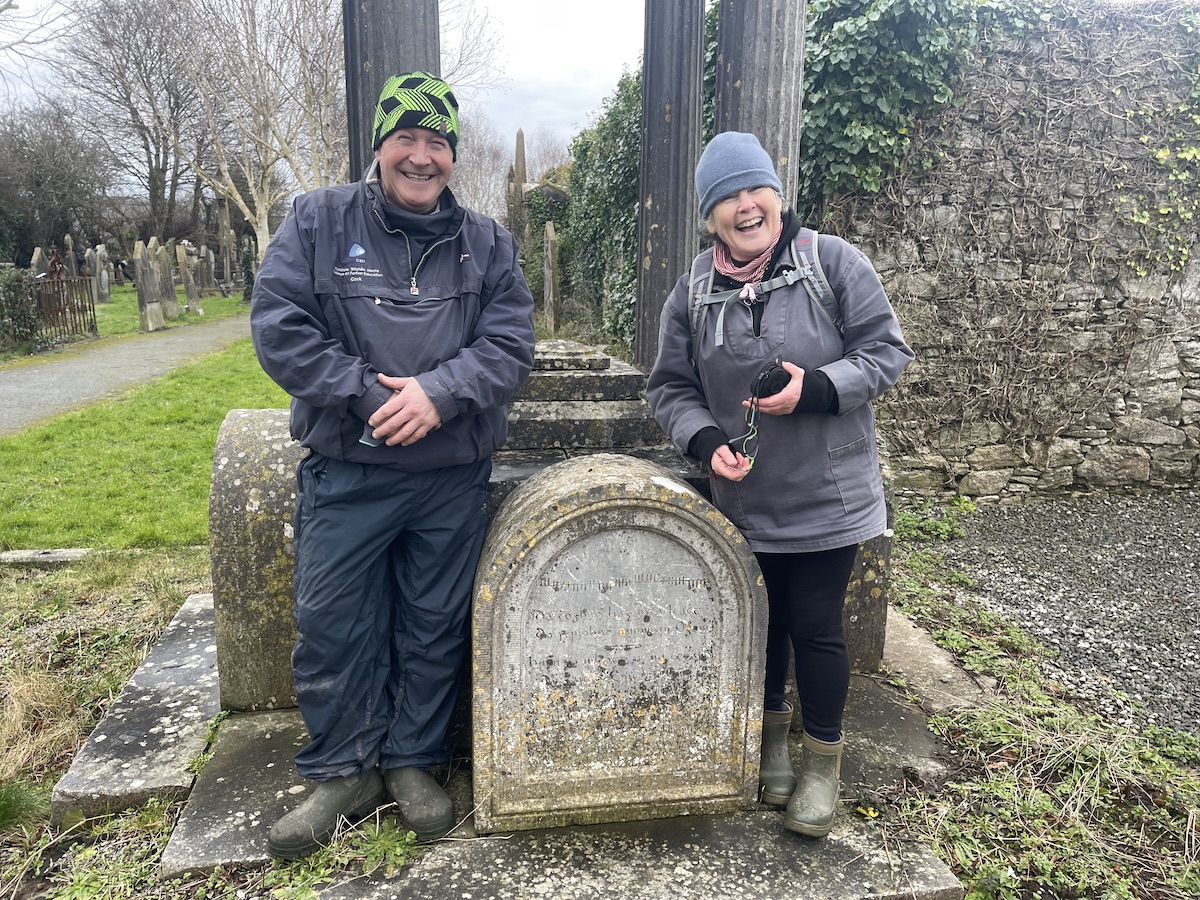
Shane Lehane Interview
Shane Lehane 0:00
What's your name, please. I'm Shane. Shane Lehane, and I'm delighted to be working with the Historic Graves project. We run a course out on the Tramore Road campus Cork College of Further Education and training. We've been working for nearly 35 years.
John Tierney 0:13
What's the course called? Shane?
SL
Yeah. So it's called Cultural and Heritage studies. It combines archaeology, history, folklore, the arts, all of those sort of areas. And we have, you know, part of the course, we have what we call work experience, where we try to get students practical hands on, valuable experience of working in the field, in the whole area of combined areas, whether it's folklore, whether it's archeology, whatever it might be, looking at the skills that are necessary for all sorts of things. So we've been, we've been running the course now, I suppose, in all the years, and we've learned as we've gone along, what kind of project works, what doesn't work. And you know, before, we used to put students out individually into different areas, but we're very much involved in people working as a team, working to people's different strengths, looking at different age groups, some people can draw, some people are agile, some people have better eyesight than others, and so on. So all of us here, we work together as a team. We have a unit. We build an agenda for the day. We have a base tea and coffee and biscuits and scones and all that is built into the whole experience. So
JT
We started in November. I was here with you, and we numbered section seven and section eight. Your team then followed on, and they read every single headstone inside in those two sections in a week. It was a lot of work.
SL
Yeah. So the process really is something that John and the team have developed, and we've kind of followed on. But what really has worked for us is the kind of systematic process that we we've developed. We work people into teams together and so and what happens really, the real game changer for us was the investment in those high luminosity torches, flashlights, and with that, we can read the inscriptions much, much better. People have brought kneeling pads. They brought seats and so on, and but a few pairs of eyes, one person with a clipboard writing the information down, the other person reading it effectively and so on. Going back to the base, the number, the record sheets have been pre numbered. They've been photographed. We have thumbnails that we look at. So it's, I think, that systemization that we've learned over the years, working with John and working with the team, how we've developed our approach, and we when we go back to class, we do an analysis of what we've done, we've done, we have a kind of a good practice sheet then that we revise before we come out and we do it again. So I think our productivity is good because we've learned along the way, and we've learned the systems that we want to employ.
JT
So St Joseph's itself. It's started as a botanic garden, 1806, something like that. Father Matthew famous in Cork lore opened it as a cemetery 1829, or 1830 but I see I'm from the other side of the city. I'm from the north side, but I see names and addresses here from where I grew up. Have you seen any from your neck of the woods?
SL
Yeah. So I have, because my maternal grandparents are here, and, you know, I, when I'm here, I go up and have a little word. And my, my, yeah. So they're up the top. That would be the Barry family. So they would be all pig buyers. They would have had incredible abattoirs in the north side of the city and Ballymacthomas and so on. So all my mother's people are here, and my my aunt Mary, who, again, we just we buried recently. So there's that kind of Yeah. She is Yeah. So big family associations always, but, but I'm with you too, as well, John, because part of what we're interested in is recognizing that the names this is, this is a, this is a canvas waiting to be uncovered. And we're seeing names, we're seeing people. We're reinvesting in people's lives, people I know, and and and people I don't know, and it's the people I don't know, and even headstones that are covered with a bit of ivy or maybe that are difficult to read, regaining those again, getting those back and giving them a presence back on this particular project is something that in future we can we can build on, and we can work on. It's going to be great.
JT
What's important for us is where your course is a multiplier, is that, like, there's over 20 students, and across the course of a week, to get 700 full inscriptions read for us is an awful lot. So we find that very powerful. And now here we are for another 400 this week. All of that data is going to be online in about a week. It's going to be findable on Google. If you google search St Joseph's Tory Top Road and say, I'm looking for particular surname, Harty, Mullins O'Brien, whatever, Google will find it for you, and it'll be your students work, then that'll be there and be read for generations.
SL
And that's what's a value to us. Because, you know, we've done different projects over the years. They've been, you know, they've sat on a folder inside, on a table, and they've been of little or no use. And what I think is terrific about this is the immediacy. Number one the searchability number two, emm I was talking to someone recently, we were saying that if we were to take and ally some of this material that we're researching here, this data set, and put it in, let's say we do genealogical work as well. So if we were looking at the births, marriages, deaths registers, or the census registers, looking at professions, looking maybe at maybe causes of death or that are recorded, that we could start reusing that material to make really effective, I suppose, determinations and analysis of our of our past. Yeah, yeah. Okay,
JT
W ell, Shane, it's always a pleasure working with Tramore Road campus classes. There's always a very positive vibe with all the students, and for me as a field surveyor, just getting so much done in such a short amount of time is a pleasure. So we appreciate your input, and
SL
listen, John, we're delighted to have the opportunity. And again, we can see this project there will be at this for the next few years, and we're so delighted. It's it's our local cemetery, it's down the road, and we're contributing to the community as well. We're in league here with Liam O'Huigín and Bara and the different local historians were dealing as well with the Ciara Brett and the city council. And you know, this has ramifications. I think this cemetery has so much more to offer, and it's really important to be involved in the embryonic stage of its development.
JT
You mentioned Liam there. He's a former student of yours. Is he? Yeah, well, Liam.
SL
Liam is a student of life, really. And I had the pleasure of having Liam on our register for a few years and but Liam would have a magnificent knowledge of history. He does guided tours here as well, and they developed that particularly over COVID and working again with Ronnie Herlihy , his work previously as well that Ronnie was a great local historian too. So they've kept that energy alive. Many, many people I know John have been on the tour of the cemetery as well. That's been huge. And Liam and company, they're all interested to find out the new data and the new material, because they can't possibly read everything. We're discovering things minute by minute here.
JT
Go raibh míle maith agat Shane!
Acknowledgements
The St. Joseph's cemetery gravestone survey is a collaboration between Cork City Council (heritage and cemeteries https://www.corkcity.ie/en/council-services/services/cemeteries/), Tramore Road Campus (Culture & Heritage and Geospatial Technology courses), and the Historic Graves Project.