In Ireland one of our largest community voluntary sporting organisations is the GAA. One key point I learned in volunteering with the GAA, was that in passing on new sporting skills, the main technique is to only coach the correct way of doing things. Don't show the wrong way, we can all work out wrong ways of doing things, but on the basis of experience and sound principles there are better, more correct, techniques to use.
If we apply this thinking to the role of AI/LLMs in Heritage then this post doesn't address the wrong way to use AI but rather will focus on the potential positive uses of AI for local heritage practitioners.
In SECreTour one of our Irish pilot tasks is to research the setting up of a national historic graveyard trail with a bottom up approach. To this end we have been developing the use of the Past in Your Pocket brochures, with eight points of interest (POIs) for a graveyard and eight more for a village/parish. These 16 POI's are 100 word information chunks designed to inform the casual visitor. Behind them are longer bodies of research and essays. Lets say we have ten groups working on this grassroots trail with each researching 16 POIs - each POI might have 1000 words of research behind written in blog post format. So ten groups x 16 POIs (100 words each) x 16 essays (1000 words each) - lets round that up to 20,000 words produced by each group so thats 200,000 words being produced by largely non-professional researchers as part of this phase of the project.
Some local historians/genealogists are extremely talented writers, lets say 5% of who we meet and they can research and write better than anybody, professional or amateur. But most of us just do our best and aspire to pass on the stories which constitute our deep knowledge based on sound research principles aiming to tell the histories via the Four W's ( who, did what, where and when). And then together we aspire to work out the fifth W - Why?
We've been using this approach for a few years in community heritage and now we believe recent AI innovations have the potential to multiply the benefits of the Four W's method. Earlier this week some computational biologists published an OpenEval methodology for parsing high-end academic articles using the concept of verifiable claims as a basis for improving the academic practice of peer review in scientific work. Now I believe all grassroots heritage is a scientific endeavour; that we are citizen scientists. If we take the basic insights of the computational biologists we can apply them to our own scientific studies to the benefit of grassroots researches, aiming to do good quality scientific recording and analysis every day. Instead of AI simply scraping local history websites and faking local voices and local stories the AI can be used to improve the quality and ambition of grassroots heritage organisations.
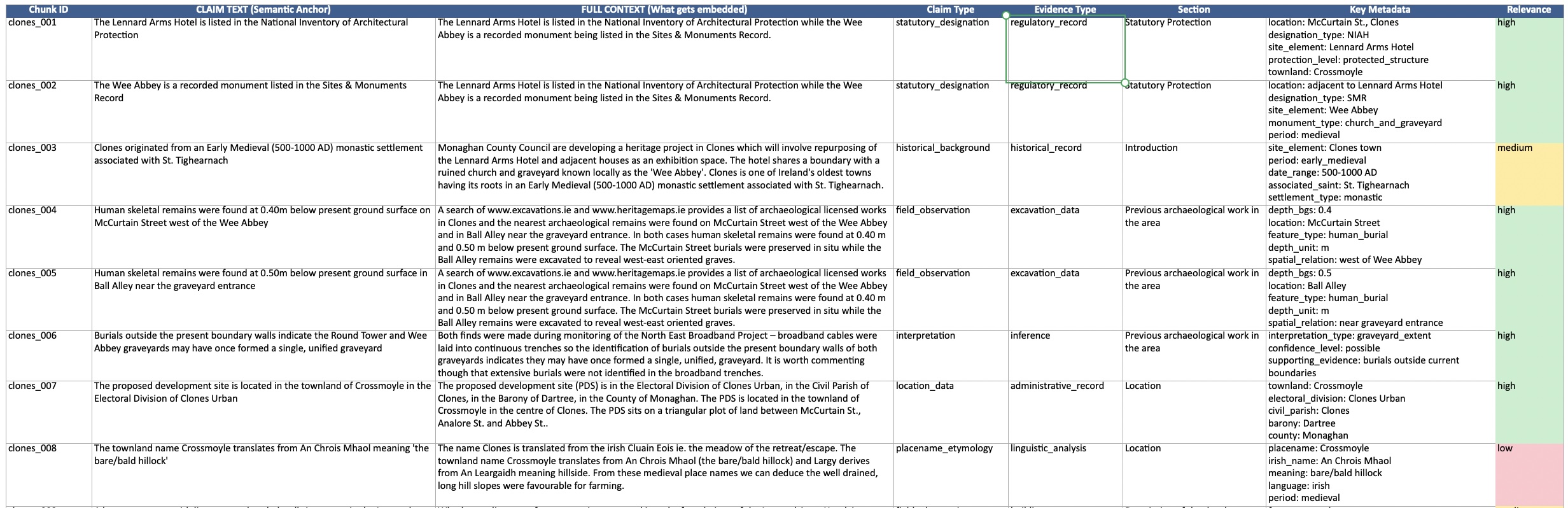
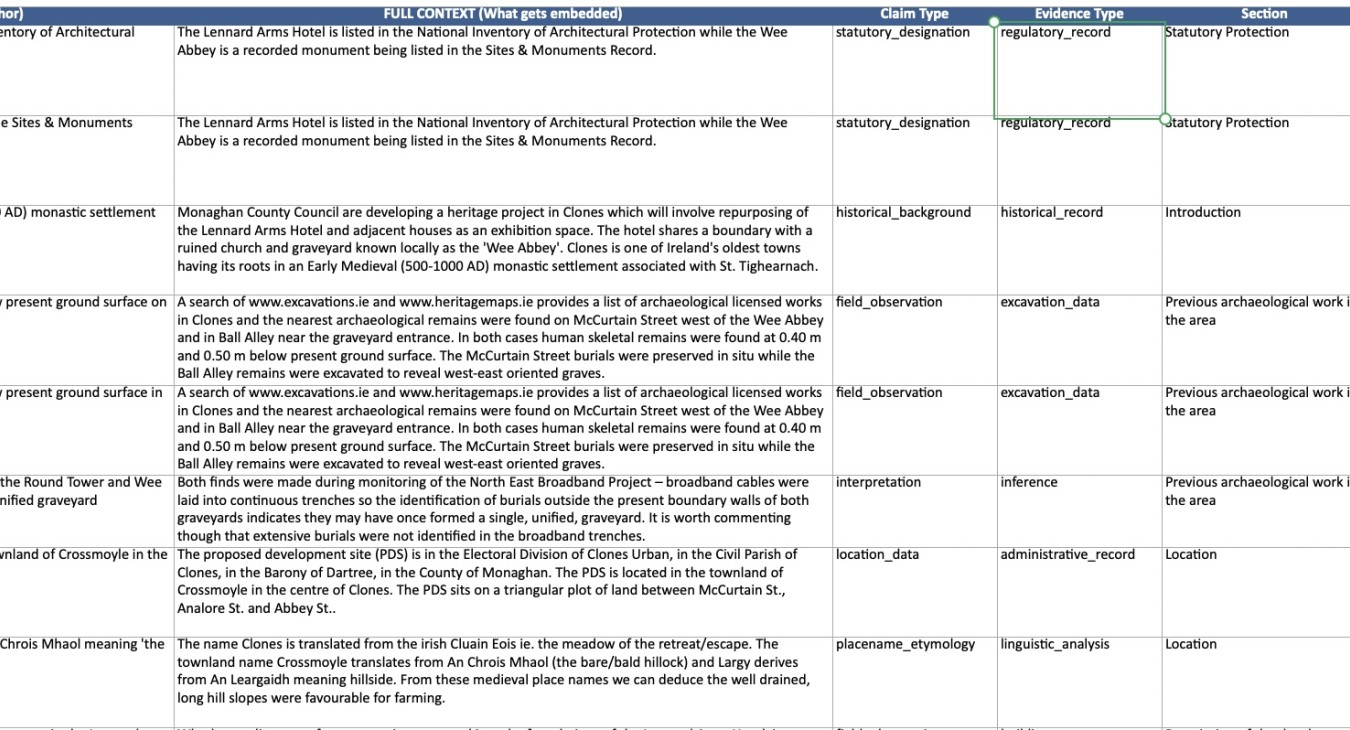
How does this work? We apply AI tech to the approach of writing informationally dense local histories. The OpenEval approach recognises our Who/What/Where/When are verifiable claims and if we pour our texts into a simple script it parses out those claims into a separate file (we are using a Vector database called ChromaDb); it then uses the claims as an anchor to identify the immediate context of the claim (lets say 1000 characters of text within which the claim sits and it extracts that contextual text also (something called chunking). Then it identifies a series of metadata that the claim sits within (like sets and subsets- the metadata allows us to fit Ardmore into a meta data list of #Waterford, #Ireland, #Medieval, #coastal, #Romanesque). So now the word document from Sheila in Duhallow is sitting in a project folder but it also been split out into a Vector Database which is organised geographically and which can grow in coming years. The Vector Database is organised so we can see how many claims we make within the usual POI/blog post/report/article, it allows us to double check our facts (verify our claims), and also then amalgamate our research across the region or country. Sheila's work from north Cork sits alongside Liam's work from West Waterford and so on, and can be queried conversationally.
The AI allows us to examine our database with these kinds of queries "I can't remember who or exactly when but is there a reference to the building of an earthwork castle in Ardmore in the early 1600s?" or "I know we have Gleeson's in the Silvermines in the 1880s but did I also read about Gleeson's near Dungarvan in the 19th century?". One can also say "Pull out all references to earthworks in Co. Waterford".
This is working now and it is accessible to non-programmers like us. In the coming months we'll be using these techniques, based on sound scientific principles with the goal of doing high quality scientific research in a scaleable manner at the grassroots. For years I used a similar manual method of doing this based on Luc Beaudoin's Cognitive Productivity book but now the AI technology has scaled this approach up a million times and made it accessible to everybody. The AI is automating and augmenting grassroots heritage workflows. There are plenty of people who are using AI to fake heritage but let them off, learn the correct techniques and drive on with gusto.